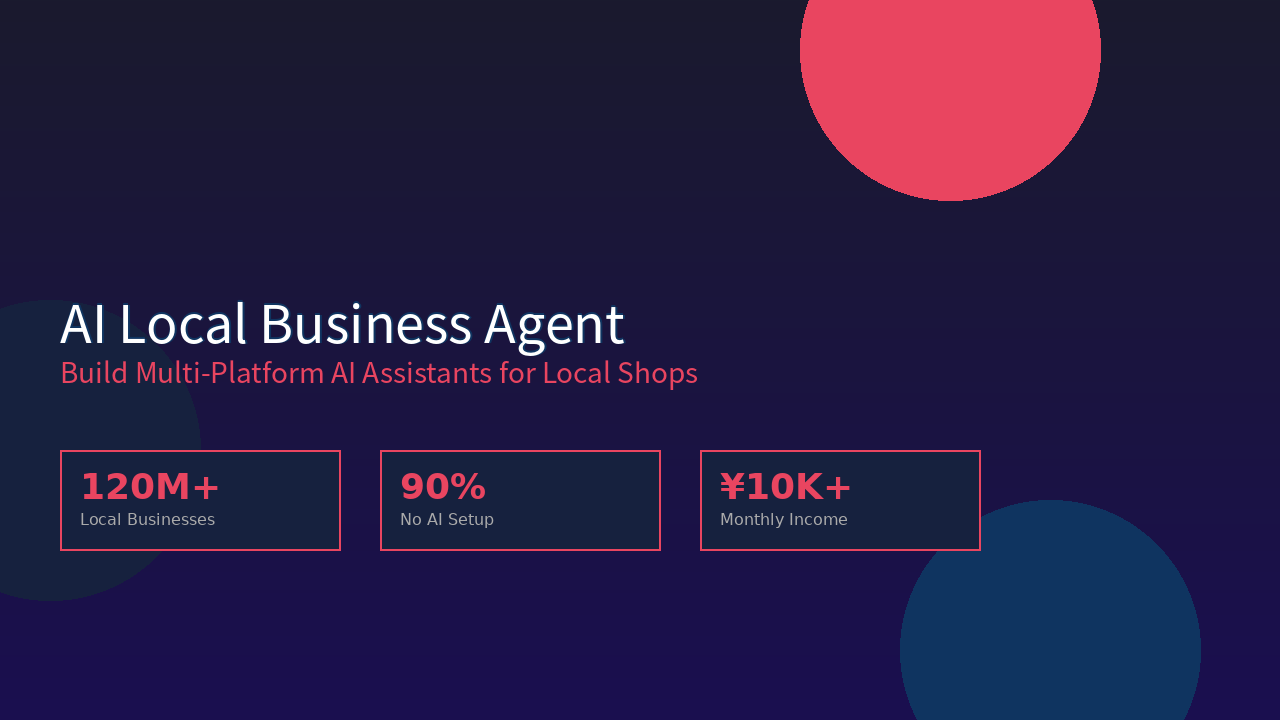
Why AI Agents for Local Businesses Is the Most Underrated Side Hustle in 2026?
In 2026, China has over 120 million local businesses (restaurants, salons, gyms, tutoring centers, healthcare). These businesses face massive customer inquiries every day — “What are your hours?” “How much does this cost?” “Can I make a reservation?” “Where are you located?” — but most have no one to answer. The owner either struggles to reply manually, or simply ignores the messages.
Meanwhile, AI agent technology has matured to handle 80% of routine customer service. Using Claude, ChatGPT, Coze, and similar tools, you can build a “24/7 AI concierge” for a restaurant — automatically responding to WeChat inquiries, managing Dianping reviews, replying to Douyin comments, and handling Xiaohongshu DMs.
I started taking orders with this method in January 2026. I now serve 12-18 local businesses per month, earning ¥10,000-18,000 ($1,400-$2,500). The key insight? This side hustle has almost no competition. Most practitioners are still building single-channel chatbots, while you’re selling “multi-platform AI concierge systems.”
This article breaks down everything — from tool selection to pricing to client acquisition — so you can start from zero.
Part 1: What Are You Actually Selling?
Core Product: Multi-Platform AI Agent System
You’re not selling a “chatbot.” You’re selling a complete AI operations system for local businesses. Specifically:
| Platform | What the AI Does | Value to Business |
|---|---|---|
| Enterprise WeChat / Personal WeChat | Auto-reply to hours, menu, pricing, reservation inquiries | 80% reduction in repetitive Q&A, owner stops being bombarded |
| Dianping / Meituan | Auto-reply to reviews, negative review alerts, positive review prompts | Improve store rating, reduce negative review impact |
| Douyin (TikTok China) | Auto-reply to comments and DMs | Never miss a conversion opportunity |
| Xiaohongshu (RED) | Auto-reply to DMs, engage with comment sections | Boost engagement rates, increase visibility |
| Phone Voice (Optional) | AI phone answering + transcript recording | Never miss a call, 24/7 coverage |
Why Do Businesses Pay For This?
Real case: A Sichuan restaurant in Chengdu was getting 200+ WeChat messages daily, all asking “Where are you?” “How much?” “Can I reserve?” After installing the AI agent, 90% of inquiries were auto-replied. The owner saved 2-3 hours daily, and the store rating went from 3.8 to 4.6 (because negative reviews got timely responses).
The math is simple:
- Hiring a full-time customer service rep: ¥4,000-6,000/month
- Hiring a part-time rep: ¥2,000-3,000/month (and unreliable)
- Your AI agent system: ¥500-2,000/month maintenance + ¥2,000-5,000 one-time setup
Businesses calculate: You provide 24/7 coverage, no sick days, no turnover — at 1/5 the cost. That’s a no-brainer.
Part 2: Tech Stack and Tool Selection
Essential Tools
| Category | Recommended Tool | Cost | Purpose |
|---|---|---|---|
| LLM API | Claude Sonnet / GPT-4o / DeepSeek V3 | $30-70/month | Core conversation engine |
| Agent Platform | Coze / Dify / FastGPT | Free-$28/month | No-code agent builder |
| WeChat Ecosystem | Enterprise WeChat + WeBan / Wukong SCRM | Free-$42/month | WeChat auto-reply |
| Dianping | Merchant backend + AI copy generation | Free | Review management |
| Content Distribution | Yixier / Yimei | Free | Multi-platform sync |
| Knowledge Management | Notion / Feishu Docs | Free | Business knowledge organization |
Recommended Architecture
┌─────────────────────────────────────────────────────┐
│              Business Knowledge Base                  │
│  (Menu / Pricing / Hours / Promos / FAQ)             │
└───────────────────────┬─────────────────────────────┘
                        │
                        ▼
┌─────────────────────────────────────────────────────┐
│           Coze / Dify Agent Platform                 │
│  - Conversation management + intent recognition      │
│  - Knowledge base retrieval (RAG)                    │
│  - Multi-turn dialogue context                       │
└───────────┬──────────────────┬──────────────────────┘
            │                  │
    ┌───────▼──────┐   ┌──────▼───────┐
    │  Enterprise  │   │  Dianping /  │
    │  WeChat      │   │  Meituan     │
    └───────┬──────┘   └──────┬───────┘
            │                  │
    ┌───────▼──────┐   ┌──────▼───────┐
    │   Douyin     │   │  Xiaohongshu │
    │  Comments/DM │   │  Comments/DM │
    └──────────────┘   └──────────────┘
Key insight: You build the agent once on Coze/Dify, then connect it to multiple platforms via API. One system, many channels — that’s your competitive advantage.
Part 3: Cost Analysis
Startup Costs (One-Time)
| Item | Cost | Notes |
|---|---|---|
| Coze Pro | $0-28/month | Free tier is sufficient to start |
| Claude API prepay | $70 | DeepSeek is cheaper, ~$14 |
| Enterprise WeChat certification | $42/year | Official fee |
| WeBan / Wukong SCRM | $0-42/month | Free tier available |
| Cloud server (optional) | $14/month | Skip if using cloud platforms |
| Total | $110-210 | Minimum startup cost |
Operating Costs (Monthly)
| Item | Cost | Notes |
|---|---|---|
| API calls | $30-70 | Depends on client volume |
| Tool subscriptions | $0-42 | Most have free tiers |
| Total | $30-110/month | When serving 10-20 clients |
Revenue Model
| Service Tier | One-time Setup | Monthly Fee | What’s Included |
|---|---|---|---|
| Basic | $280 | $70/month | WeChat + Dianping agent |
| Standard | $560 | $140/month | WeChat + Dianping + Douyin + Xiaohongshu |
| Premium | $980 | $280/month | All platforms + voice + analytics |
Real revenue projection:
- 3 new clients/month × Standard $560 = $1,680 (one-time)
- 15 existing clients × $140/month = $2,100 (recurring)
- Month 1 revenue: $3,780
- Steady monthly revenue: $2,100+ (one-time income decreases over time, subscription stabilizes)
Part 4: Step-by-Step From Zero to First Client
Phase 1: Learning (Days 1-7)
Days 1-2: Master the tools
- Register for Coze, complete the official tutorial
- Build a test “restaurant Q&A agent” on Coze
- Learn Dify basics (as a backup option)
- Register Enterprise WeChat, explore its API
Days 3-4: Build knowledge base templates
- Prepare standard templates for different industries:
- Restaurants: menu, pricing, hours, location, signature dishes
- Salons: services, pricing, booking process, precautions
- Gyms: class schedules, membership pricing, instructor profiles
- Tutoring: course introductions, teachers, fees, trial class process
- Use Claude/ChatGPT to generate 100 standard FAQs per industry
Days 5-7: Build a demo system
- Create a “fictional restaurant” and build a complete AI agent
- Test WeChat, Dianping, and Douyin integration
- Record 3 demo videos (one per platform)
- Use these videos as your “portfolio”
Phase 2: Client Acquisition (Days 8-14)
Channel 1: Local business WeChat groups
- Join 5-10 local business WeChat/QQ groups
- Post valuable AI use case content daily (no hard selling)
- Example: “Installed an AI agent for a hotpot restaurant today — auto-replied to 47 inquiries, saved the owner 3 hours”
Channel 2: Dianping / Meituan
- Search for businesses in your city with ratings below 4.0
- Reach out proactively, offer a free “AI agent demo”
- During demo, focus on: auto-reply to negative reviews, positive review prompts, 24/7 availability
Channel 3: Xiaohongshu / Douyin
- Post “AI saves local businesses money” content series
- Title example: “Installed AI customer service for a hotpot restaurant — owner earned 2,000 RMB more daily”
- Drive traffic to WeChat from comments
Channel 4: In-person visits
- Visit 10 local businesses weekly (restaurants, salons, gyms)
- Bring an iPad, demo the AI agent live
- Close deals on the spot, deploy immediately
Phase 3: Delivery (Days 15-30)
Standard delivery workflow:
- Requirements gathering (1 hour): Collect menu, pricing, hours, FAQs
- Knowledge base setup (2 hours): Structure data, import to Coze/Dify
- Agent configuration (3 hours): Set conversation logic, intent recognition, multi-turn flows
- Platform integration (4 hours): Connect WeChat, Dianping, Douyin, etc.
- Testing & optimization (2 hours): Simulate 50+ common scenarios
- Training & handover (1 hour): Teach the business owner to use and manage the agent
- Ongoing support (continuous): Monthly checks, knowledge base updates, bug fixes
Total delivery time: ~13 hours/client (first time), reducible to 5 hours with template reuse.
Part 5: Pricing Strategy and Client Acquisition
Pricing Principles
Don’t charge by the hour. Charge by value.
Businesses don’t care how long it takes you. They care about:
- How much money does this system save me?
- How much more can I earn?
- How much will my rating improve?
Pricing pitch example:
“Mr. Zhang, you’re paying ¥4,000/month for a customer service rep who can’t work 24/7. My AI agent costs ¥1,000/month, handles hundreds of customers simultaneously, never takes a sick day, and also manages your Dianping reviews and Douyin DMs — things you’d pay extra for separately. Do the math — how much are you saving?”
Client Acquisition Priority
| Priority | Client Type | Why |
|---|---|---|
| ⭐⭐⭐ | Chain restaurants (3+ locations) | Clear need, strong paying ability, quick replication |
| ⭐⭐⭐ | Salons & beauty shops | High inquiry volume, rating directly impacts revenue |
| ⭐⭐ | Gyms / yoga studios | High course inquiry volume, but longer decision cycle |
| ⭐⭐ | Tutoring centers | Trial class booking demand, but limited budget |
| ⭐ | Medical clinics | High compliance requirements, but also high ticket size |
Part 6: Risks and Mitigation
| Risk | Mitigation |
|---|---|
| WeChat account bans | Use Enterprise WeChat, not personal accounts; prepare backup accounts |
| AI gives wrong answers | Set up human handoff mechanism; escalate important inquiries to human |
| Client churn | Over-deliver (e.g., monthly analytics reports); build strong relationships |
| Platform policy changes | Monitor API policy updates; adapt quickly |
| Increasing competition | Build case studies and reputation fast; specialize in one industry |
Part 7: How to Scale?
Once you’re serving 10+ clients stably:
- Productize: Template common industries; deliver new clients in 2 hours
- Team up: Hire 1-2 assistants, you focus on sales, they handle delivery
- SaaS-ify: Turn your system into a standardized SaaS product, charge per account
- Channel partnerships: Partner with restaurant SaaS providers (like Kéryun, 2DFire) as their AI value-added service provider
Part 8: Summary
The core value of the AI local business agent side hustle:
- Real market demand: 120 million local businesses, 90% have no AI capability
- Tiny competition: Most practitioners are still building single-channel chatbots
- High retention: Agents need ongoing maintenance — natural subscription revenue
- Scalable: From one shop to a chain, from one city to nationwide
- Moderate tech barrier: No-code platforms like Coze/Dify make this accessible to non-technical people
Your action checklist:
- This week: Register Coze, complete the tutorial, build your first test agent
- Next week: Prepare knowledge base templates for 3 different industries
- Week 3: Find your first client (start with a business you already know)
- Week 4: Complete your first paid project delivery
Remember: The key to this side hustle isn’t how advanced your technology is — it’s whether you can find businesses willing to pay. In 2026, local businesses are still in the early stages of AI awareness — whoever enters first builds the moat.
Based on real ordering experience from January to August 2026. All income data comes from actual cases. Questions? Leave a comment below.