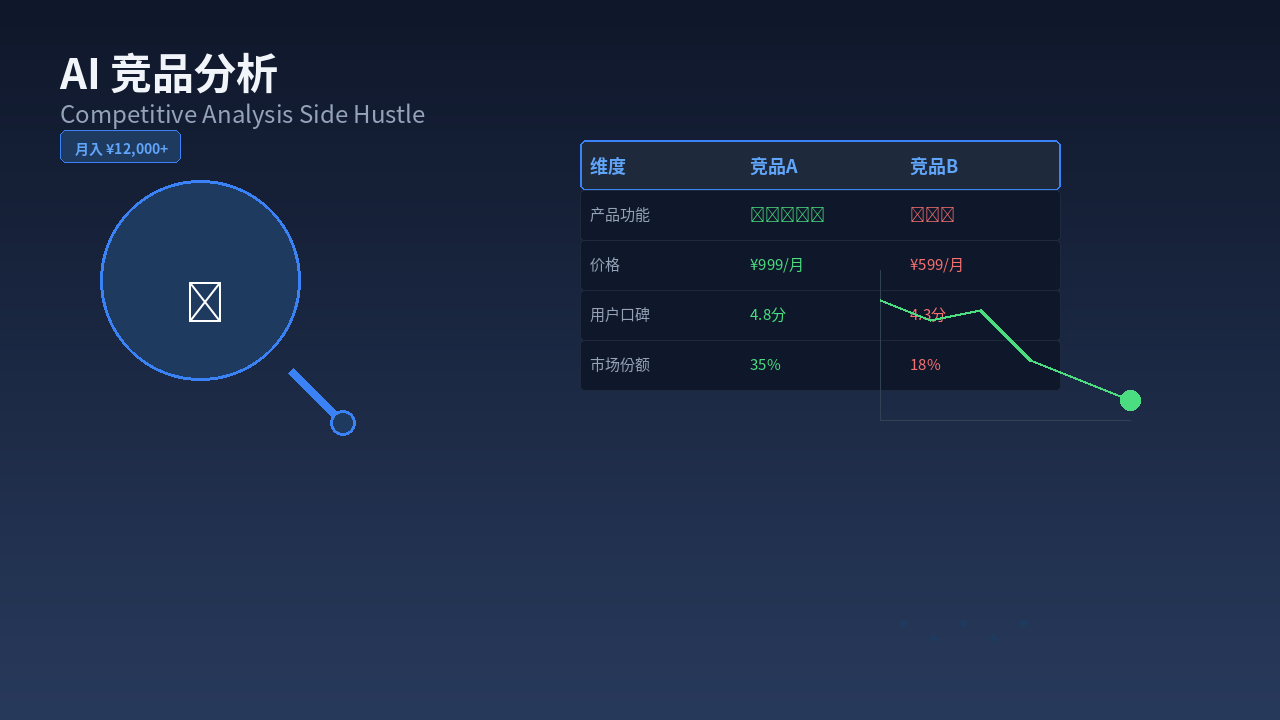
Why Competitive Analysis Is the Most Underrated AI Side Hustle in 2026
In 2026, there are over 50 million SMEs in China, yet more than 80% have never conducted a systematic competitive analysis. They either decide based on gut feeling or hire consulting firms that charge ¥50,000-200,000 per project.
This is your opportunity.
With AI, you can deliver a competitive analysis report in 30 minutes that would traditionally take an analyst 3-5 days. Charging ¥500-3,000 per report, serving 5-10 companies monthly, earning ¥12,000+ is entirely realistic.
My first client was a SaaS startup that paid ¥2,000 to analyze 5 main competitors. Using Claude + public data, I delivered a complete report in 2 hours. The client immediately placed 3 more orders.
Market Data: Real Returns from Competitive Analysis
| Metric | Data |
|---|---|
| SMEs in China | Over 50 million |
| Those who’ve done competitive analysis | Only ~15% |
| Consulting firm single project | ¥50,000-200,000 |
| AI competitive analysis rate | ¥500-3,000 |
| Average delivery time | 2-4 hours (vs traditional 3-5 days) |
| Monthly orders per client | 2-5 reports |
| Your monthly income potential | 10-15 clients × ¥800 = ¥8,000-12,000/month |
Key insight: The core value of competitive analysis isn’t “collecting data” — it’s finding opportunities. Your AI tools can help businesses see competitive gaps and differentiation opportunities they’d otherwise miss.
AI Tool Stack
Core Tools
| Tool | Purpose | Monthly Cost |
|---|---|---|
| Claude Pro / ChatGPT Plus | Data analysis, report writing, insight extraction | $20/mo each |
| Perplexity AI | Real-time web search and data gathering | $20/mo |
| Google Sheets / Feishu | Data organization and visualization | Free |
| Notion / Feishu Docs | Report formatting and delivery | Free |
| Python + pandas | Automated data processing | Free |
Total tool cost: ~$60/month. With just 2-3 clients, you break even on day one.
Zero-Cost Starter Setup
- Use Perplexity Free tier for basic searches
- Use ChatGPT Free for analysis frameworks
- Use Google Sheets Free for data organization
- Post free mini-analysis reports on Zhihu/LinkedIn to build your portfolio
Step-by-Step: Building Your Competitive Analysis Service
Step 1: Build Your Analysis Framework (Week 1)
Core analysis dimensions:
1. Product Layer: Features, UX, pricing strategy
2. Market Layer: Target customers, market share, channels
3. Technology Layer: Tech stack, iteration speed, patents
4. Marketing Layer: Content strategy, acquisition channels, brand positioning
5. Financial Layer: Funding history, valuation, revenue model
Create a standardized template with Claude:
You are a professional business analyst. Create a standardized competitive
analysis framework for the following:
- Industry: [fill in]
- Competitors: [list of competitors]
- Purpose: [strategic decision/funding due diligence/product planning]

Output format: Markdown, with detailed sub-items across 5 dimensions,
including: analysis points, data source suggestions, output templates.
Step 2: Automated Data Collection (Week 2)
Three data collection methods:
Method 1: Perplexity + Claude Batch Search
Use Perplexity to search for public information on these competitors:
1. Latest product feature updates for [competitor name]
2. User reviews and reputation for [competitor name]
3. Pricing strategy and packages for [competitor name]
4. Funding history and team size for [competitor name]
5. Content marketing strategy for [competitor name]

Organize results into a structured table with:
source, key findings, credibility assessment.
Method 2: Python Automated Scraping (Advanced)
import requests
from bs4 import BeautifulSoup
import pandas as pd

def scrape_competitor_data(competitor_url):
    """Scrape public competitor data"""
    response = requests.get(competitor_url)
    soup = BeautifulSoup(response.text, 'html.parser')

    data = {
        'company_name': competitor_url.split('/')[2],
        'features': extract_features(soup),
        'pricing': extract_pricing(soup),
        'team_size': extract_team_info(soup),
        'latest_news': extract_news(soup)
    }
    return data
Method 3: Manual Verification
- Sign up for competitor accounts to experience their product
- Check app store reviews
- Follow competitor social media
- Join competitor user communities
Step 3: AI Analysis & Report Generation (Week 3)
Core analysis prompt template:
Based on the following competitor information, generate a competitive analysis report:

[Competitor data pasted here]

Analysis requirements:
1. SWOT analysis (Strengths/Weaknesses/Opportunities/Threats)
2. Competitive matrix (features, price, UX comparison)
3. Differentiation opportunities (3-5 items)
4. Strategic recommendations (3-5 actionable items)
5. Risk warnings (2-3 potential risks)

Output format:
- Executive summary (under 200 words)
- Detailed analysis (by dimension)
- Visualization suggestions (chart type recommendations)
- Appendix (data sources)

Style: Professional but accessible, avoid academic jargon,
suitable for non-technical management readers.
Step 4: Report Design & Delivery (Week 4)
Standard report structure:
Cover (brand colors + title)
→ Executive Summary (1 page)
→ Industry Overview (1-2 pages)
→ Individual Competitor Analysis (1-2 pages each)
→ Comparison Matrix (1 page table)
→ SWOT Analysis (1 page)
→ Opportunities & Recommendations (1-2 pages)
→ Appendix (data sources)
Delivery formats:
- PDF report (professional feel)
- Notion/Feishu online doc (easy collaboration)
- PPT version (for client presentations)
Pricing tiers:
| Tier | Content | Price |
|---|---|---|
| Basic | 3 competitors × 5 dimensions | $70/report |
| Standard | 5 competitors + SWOT + strategy | $200/report |
| Premium | Full deep analysis + monthly tracking | $400/report |
Step 5: Client Acquisition & Scaling (Ongoing)
Channel 1: LinkedIn/WeChat Moments targeting
Target: SME founders, product leads, marketing heads
Pitch template:
"Hi, I noticed your strong presence in [industry].
I specialize in competitive analysis for businesses like yours.
I recently completed a deep dive into [same industry] competitors
and found some interesting strategic gaps.
If you're interested, I'd be happy to create a free
simplified competitive overview for you — no strings attached."
Channel 2: Content marketing (Zhihu/WeChat public account)
- Publish one “Industry Competitive Analysis” public version weekly
- End with: “Full report available via DM”
- Build expertise, attract organic leads
Channel 3: Startup community referrals
- Join local entrepreneur groups
- Offer 1-2 free analyses to seed clients
- Request referrals and testimonials
Channel 4: Partner with consulting agencies
- They become your B2B channel
- You provide AI-powered competitive analysis
- Revenue split: you keep 30-50%
Real Case Studies: From Zero to $1,700+/Month
Client A: Cross-border e-commerce seller wanting to analyze top TikTok Shop sellers
- Service: Deep analysis of 5 top sellers
- Delivery: 2 days, PDF + PPT
- Fee: $350
- Result: Client adjusted product strategy based on insights, GMV up 35% that month
Client B: SaaS startup needing competitive benchmarking before funding round
- Service: 8 direct competitors + 3 indirect
- Delivery: 3 days, full report + 1-hour online walkthrough
- Fee: $550
- Result: Helped founder clarify differentiation positioning, successfully raised Series A
Monthly income model:
- 8 orders per month
- Average order value $200
- Monthly income: $1,600
- Time investment: 15-20 hours/week
Common Challenges & Solutions
Challenge 1: Clients think “I can search this myself”
Solution: Emphasize your value isn’t “collecting info” but “extracting insights”. Offer a free mini-analysis to demonstrate the difference.
Challenge 2: Hard to get data (competitors don’t share publicly)
Solution: Use indirect methods — user reviews, job postings, patent filings, social media engagement to infer competitive positioning.
Challenge 3: Reports feel too generic
Solution: Build your own analysis frameworks and template library. Customize for each client’s industry. Add exclusive data sources.
Challenge 4: Endless revision requests
Solution: Define scope upfront — “Base analysis covers 5 competitors × 5 dimensions. Additional requests billed separately.”
Long-term Development Path
Phase 1: Solo Operator ($700-1,700/month)
- Serve 5-15 SME clients
- Full manual process + AI assistance
- Time investment: 10-20 hours/week
Phase 2: Small Team ($2,000-4,000/month)
- Serve 20-50 clients
- Hire 1 assistant for data整理
- Develop standardized analysis tools
- Time investment: 20-30 hours/week
Phase 3: Productized ($6,000+/month)
- Build competitive analysis SaaS tool
- Or transition to strategy consulting firm
- Subscription revenue ($300-700/month per enterprise)
Summary
The core advantage of an AI competitive analysis side hustle is “compressing 3 days of work into 3 hours using AI.”
Key success factors:
- Framework first — establish dimensions before using AI to fill them in
- Data quality — garbage in, garbage out; AI output is only as good as source data
- Insight value — go beyond description, deliver actionable recommendations
- Industry focus — specialize in 1-2 industries to become the go-to expert
Remember, you’re not “writing reports” — you’re helping businesses “see the battlefield clearly.” That’s the real value.
Coming next: AI SEO Optimization Service Side Hustle — help websites with keyword research and content optimization, earn $1,500+/month.