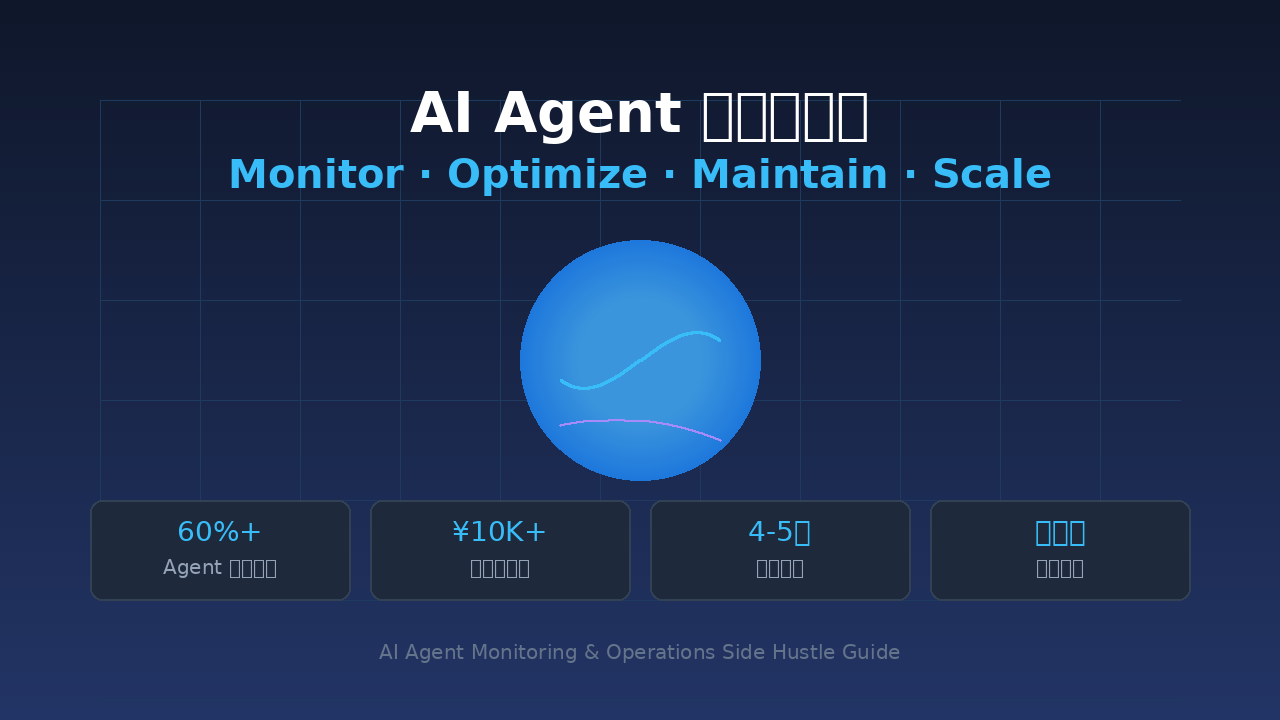
Why AI Agent Monitoring Is Exploding in 2026
In 2026, more and more businesses have deployed AI Agents — intelligent customer service, automated sales assistants, internal knowledge bases, smart scheduling. But a severely overlooked problem emerges: deployment is just the beginning; operations is where the real work lies.
Unlike traditional software, AI Agents are non-deterministic by nature. An agent that performs perfectly today might give wrong answers next week due to subtle changes in input data or prompt behavior. Last month’s cost-controlled agent might see its API bill multiply tenfold next month due to unexpected usage spikes.
According to Gartner’s latest report, over 60% of enterprise AI Agent deployments experience some degree of performance degradation or cost overrun after launch. Meanwhile, the market has virtually zero professionals specializing in AI Agent monitoring and operations.
This is your opportunity.
Your value proposition is clear: help businesses monitor, maintain, and optimize their deployed AI Agents — ensuring continuous stability, cost control, and excellent user experience.
What Can You Offer as an AI Agent Monitor?
1. AI Agent Performance Monitoring & Drift Detection
The scenario: An e-commerce company deployed a GPT-4-based intelligent customer service agent. Customer satisfaction was 95% in the first month. Three months later, it dropped to 72%, but nobody knew why — the customer service team said the AI got dumber, and the tech team said the code hadn’t changed.
Your service:
- Build an agent behavior monitoring system tracking key metrics (accuracy, response time, user satisfaction)
- Implement data drift detection: alert automatically when input data distributions shift
- Set up A/B testing frameworks to compare different prompt versions
- Deliver monthly performance reports with actionable insights
Tech stack: LangSmith, LangFuse, Arize Phoenix, custom Python monitoring scripts Investment: ~1 week to learn LangSmith/LangFuse, 2 weeks to build monitoring infrastructure Revenue: Monthly monitoring ¥2,000-8,000/client, one-time setup ¥3,000-15,000
2. AI Agent Cost Control & Optimization
The scenario: A SaaS company used Claude API for intelligent ticket classification. Month one: ¥8,000. Month two: ¥35,000 — turns out duplicate requests weren’t cached, and prompts were unnecessarily long.
Your service:
- Analyze API call patterns to identify waste
- Implement request caching, prompt compression, token optimization
- Design hybrid model strategies: cheap small models for simple tasks, expensive large models for complex ones
- Build cost dashboards for real-time spending visibility
Tech stack: OpenTelemetry, custom cost-tracking scripts, Redis caching, prompt optimization tools Investment: 1 week to learn API cost optimization methods, tools are free Revenue: 20-30% of saved costs, or fixed fee ¥3,000-10,000/month
3. AI Agent Incident Diagnosis & Recovery
The scenario: An education company’s AI tutor started generating nonsense one day. Student complaints surged. The tech team spent two days searching for the cause — eventually discovered someone accidentally modified a prompt template.
Your service:
- Build agent health-check systems with real-time monitoring of critical functions
- Implement automated recovery: rollback to last stable version when anomalies detected
- Establish log analysis and root-cause investigation workflows
- Offer 7×24 emergency response service
Tech stack: Prometheus + Grafana, ELK Stack, CI/CD rollback scripts, custom health checks Investment: 2-3 weeks to learn monitoring toolchains, 1 week for automated recovery Revenue: Basic monitoring ¥1,500-5,000/month, with emergency response ¥5,000-15,000/month
4. AI Agent Compliance & Security Continuous Monitoring
The scenario: A financial institution’s AI investment advisor was flagged during a regulatory audit for occasionally providing unverified market predictions. Not illegal, but a compliance risk.
Your service:
- Build continuous compliance check pipelines that auto-detect rule violations in agent outputs
- Implement content filtering and output verification layers
- Generate compliance audit reports meeting regulatory requirements
- Regularly update compliance rule libraries to adapt to regulation changes
Tech stack: Custom compliance check scripts, Guardrails AI, regex rule engines, audit logging Investment: 1-2 weeks to learn compliance checking methods, tools mostly open-source Revenue: Compliance monitoring ¥5,000-20,000/month, compliance reports ¥3,000-10,000/report
Core Skills You Need
Fundamentals (Weeks 1-2)
-
AI Agent Architecture Understanding:
- Understand agent components: LLM, prompts, tool calls, memory systems
- Familiarize with common frameworks: LangChain, CrewAI, AutoGen
- Master typical deployment patterns: API services, WebSocket, scheduled tasks
-
Monitoring Basics:
- What is data drift and concept drift
- Key performance indicator (KPI) selection and design
- Alert threshold setting and notification mechanisms
Tool Mastery (Weeks 3-4)
- LangSmith: LangChain’s official agent observability platform — tracing, evaluation, debugging
- LangFuse: Open-source LLM app monitoring — cost tracking and performance analysis
- Arize Phoenix: Experiment tracking and monitoring designed for ML/LLM applications
- Prometheus + Grafana: Classic monitoring/alerting combo for agent health checks
- OpenTelemetry: Distributed tracing standard for cross-service链路 tracking
Practical Skills (Week 5+)
- Build comprehensive monitoring dashboards: Integrate performance, cost, compliance data
- Write automated alert rules: Set reasonable thresholds based on business scenarios
- Incident diagnosis methodology: Systematic root-cause analysis from symptoms to source
- Client communication: Translate technical issues into business language
Investment & Revenue Expectations
Startup Costs
| Item | Cost |
|---|---|
| Learning time | 4-5 weeks (10-15 hrs/week) |
| Tool costs | ¥0-500/month (LangSmith free tier sufficient) |
| Cloud server | ¥200-500/month (for monitoring services) |
| Personal brand/website | ¥500-2,000 (domain + hosting) |
| Total | ~¥1,000-3,000 |
Revenue Model
| Service Type | Price | Monthly Clients | Monthly Revenue |
|---|---|---|---|
| Basic Performance Monitoring | ¥2,000-5,000/month | 3-5 | ¥6,000-25,000 |
| Cost Optimization | ¥3,000-10,000/month | 2-3 | ¥6,000-30,000 |
| Incident Response | ¥5,000-15,000/month | 2-4 | ¥10,000-60,000 |
| Compliance Monitoring | ¥5,000-20,000/month | 1-3 | ¥5,000-60,000 |
| Comprehensive Ops Package | ¥10,000-30,000/month | 2-4 | ¥20,000-120,000 |
Conservative estimate: ¥10,000-20,000/month (part-time, 3-5 clients) Optimistic estimate: ¥30,000-50,000/month (full-time, 8-15 clients)
Step-by-Step: From Zero to First Client
Weeks 1-4: Learning Phase
- Week 1: Install LangSmith and LangFuse. Experimentally monitor a public AI Agent (e.g., a simple Q&A bot built with LangChain).
- Week 2: Learn data drift detection methods. Use LangSmith’s evaluation features to compare different prompt versions.
- Week 3: Build a Prometheus + Grafana dashboard monitoring agent response times and success rates.
- Week 4: Write a technical article on “Best Practices for AI Agent Monitoring” and publish on your blog, Zhihu, or V2EX.
Weeks 5-8: Client Acquisition
- List services on Upwork/Fiverr: Keywords include “AI monitoring,” “LLM observability,” “Agent debugging.”
- Reach out to companies using AI Agents: Find companies on Product Hunt, Hacker News, Twitter actively using AI Agents. Offer free preliminary assessments.
- Build influence in tech communities: Share AI monitoring articles on V2EX, Juejin, Zhihu.
- Create an open-source monitoring template: Release a generic AI Agent monitoring dashboard template to attract potential clients.
Weeks 9-12: Delivery Phase
- Land your first paid project: Even at ¥1,000-2,000, deliver excellently to earn reviews and referrals.
- Establish a standardized service process:
- Requirements assessment → Current-state audit → Solution design → Deployment → Continuous optimization
- Build a monitoring template library: Create industry-specific monitoring templates (e-commerce, education, finance).
- Leverage referrals: Each satisfied client can refer 2-3 similar prospects.
FAQ
Q: I have no ops experience. Can I do AI Agent monitoring? A: Absolutely. AI Agent monitoring differs from traditional ops — it focuses on AI-specific issues (drift, hallucination, cost overruns). You don’t need Kubernetes or complex networking knowledge. Mastering tools like LangSmith and LangFuse is enough to start.
Q: Do I need coding skills? A: Basic level suffices. LangSmith and LangFuse offer visual interfaces — most configuration is UI-based. Some Python helps for custom alert rules or data processing, but it’s not mandatory.
Q: Where do clients come from? A: Main channels: (1) SMEs that have deployed AI Agents and are experiencing problems; (2) AI Agent development companies needing post-delivery support partners; (3) Content marketing in tech communities — sharing monitoring knowledge attracts clients organically.
Q: How sustainable is this side hustle? A: As long as businesses use AI Agents, monitoring and operations will be needed. And as agents grow more complex, monitoring needs only increase. This becomes more valuable over time — your monitoring experience and industry-specific templates become increasingly defensible moats.
Summary
AI Agent monitoring and operations is a high-demand, low-competition, sustainable side hustle. Its core advantages:
- Real and urgent market demand: Companies deployed many AI Agents but nobody manages their daily performance
- Near-zero competition: Virtually no individual service providers specialize in AI Agent monitoring
- Reasonable entry barrier: 4-5 weeks of learning to start taking orders; tools are mostly free
- High revenue ceiling: From ¥2,000/month basic monitoring to ¥30,000/month comprehensive ops packages
- Scalable: Once you build industry-specific monitoring templates, replicating for new clients has near-zero marginal cost
If you have some technical background but don’t want to pursue traditional DevOps, AI Agent monitoring and operations may be one of the most worthwhile side hustles to invest in during 2026.